
- DATE : 19/09/2024 19/09/2024
- TIME : 17:15–18:15
- VENUE : Hunter Lecture Theatre, 74 Lauriston Place
2024 Spotlight Taiwan Taiwan Lecture, University of Edinburgh
2024 History of Art Research Seminar, Edinburgh College of Art, University of Edinburgh
Time: 19 September 2024 17:15-18:15, followed by a drink reception
Venue: The Hunter Lecture Theatre, Edinburgh College of Art, University of Edinburgh.
74 Lauriston Place Edinburgh EH3 9DF, United Kingdom
*The event is sponsored by the 2024 Spotlight Taiwan Project funded by the Ministry of Culture, Taiwan.
Speaker: Dr Meng-Hung SU
Title: SELF-EXOTICISM
The Bonhams London’s auction site lists a lot of four Qing-dynasty cloisonné enamel flower panels previously owned by Lady Anne M.S. Durston. Having chanced upon this web page, the artist couldn’t help but imagine: When Lady Durston looked at the object that had travelled so far from an exotic, distant culture, a feeling of wonder arose in her, who marvelled at the style, motif, and palette of this splendid relic. This exoticism mirrors the fantasy of replacing ocalization, estranged from the object’s state of being, nestling this longing in an otherness that transports the viewer to a heterogeneous space. Su continues his pursuit of realist imagery through craftsmanship, as well as his use of traditional flora and fauna paintings and decorative patterns in Self-exoticism, his latest solo exhibition. Layers upon layers of paint are applied onto the canvas through flat-colouring and screen-printing before the artist sands them down in an attempt to cancel the materiality of the pigments themselves while concealing the physical labour and traces of time during the art-making process.
About the Speaker:
Dr Meng-Hung SU
 Meng-Hung Su works across such mediums as painting, silkscreen printing, installation, and sculpture in a creative process that manifests his attempt to transform traditional Chinese imagery of flowers and birds into a visual vocabulary of gaudy and grandiose icons, or into a cultural language of sensuous and appealing symbols. He often adapts elements of flowers and birds from the work of late Qing-dynasty painters. These visual symbols are not merely driven by the artist’s desire to ridicule social codes or to popularise the symbols In mass culture.
Instead of merely representing the taste of the aristocracy and literati instantiated by these flowers and birds, he blends the contradictory forces of contemporary visual experience. This allows the viewer, while identifying cultural symbols, to enter an open or closed system, engaged in a way of thinking that hearkens back to a historical era that has long gone. If we see the blending of East and West in Giuseppe Castiglione’s painting style, then Meng-Hung Su, on the other hand, grapples with the materiality of pigments using techniques such as simulation, xipi (literally meaning rhinoceros hide, a term describing marbled lacquer surface, formed by layers of differently coloured lacquer applied to an uneven surface), mother-of-pearl inlay, even cloisonné. His work ultimately responds to the re-amalgamation of Eastern and Western craft histories, while interrogating the production of art within capitalism.
Su’s notable solo exhibitions include Self-Exoticism, Tina Keng Gallery, Taipei, Taiwan (2021); Xiang Nai Er, Tina Keng Gallery, Taipei, Taiwan (2019); A Painter of the Empire, Tina Keng Gallery, Taipei, Taiwan (2016); Poppy, Golden Lotus, Dopamine, Tina Keng Gallery, Taipei, Taiwan (2012); and Unreachable Blooming, IT Park, Taipei, Taiwan (2007). He has also participated in international exhibitions and biennials, including Dialogue on Printmaking — The Taiwan-U.S. Exchange Exhibition, Taiwan Academy, Taipei Economic and Cultural Office in New York, New York, U.S. (2016); Taipei Biennial (2014), Taiwan; and Jam — Cultural Congestions in Contemporary Asian Art, South Hill Park Art Centre, Bracknell, U.K. (2009).

Solitary Phoenix Haunting Golden Swirls 2022 Cypress, acrylic, and canvas Four-panel double-sided screen, each panel:195 x 41.5 cm, Phoenix:5 x W42 x D31 cm
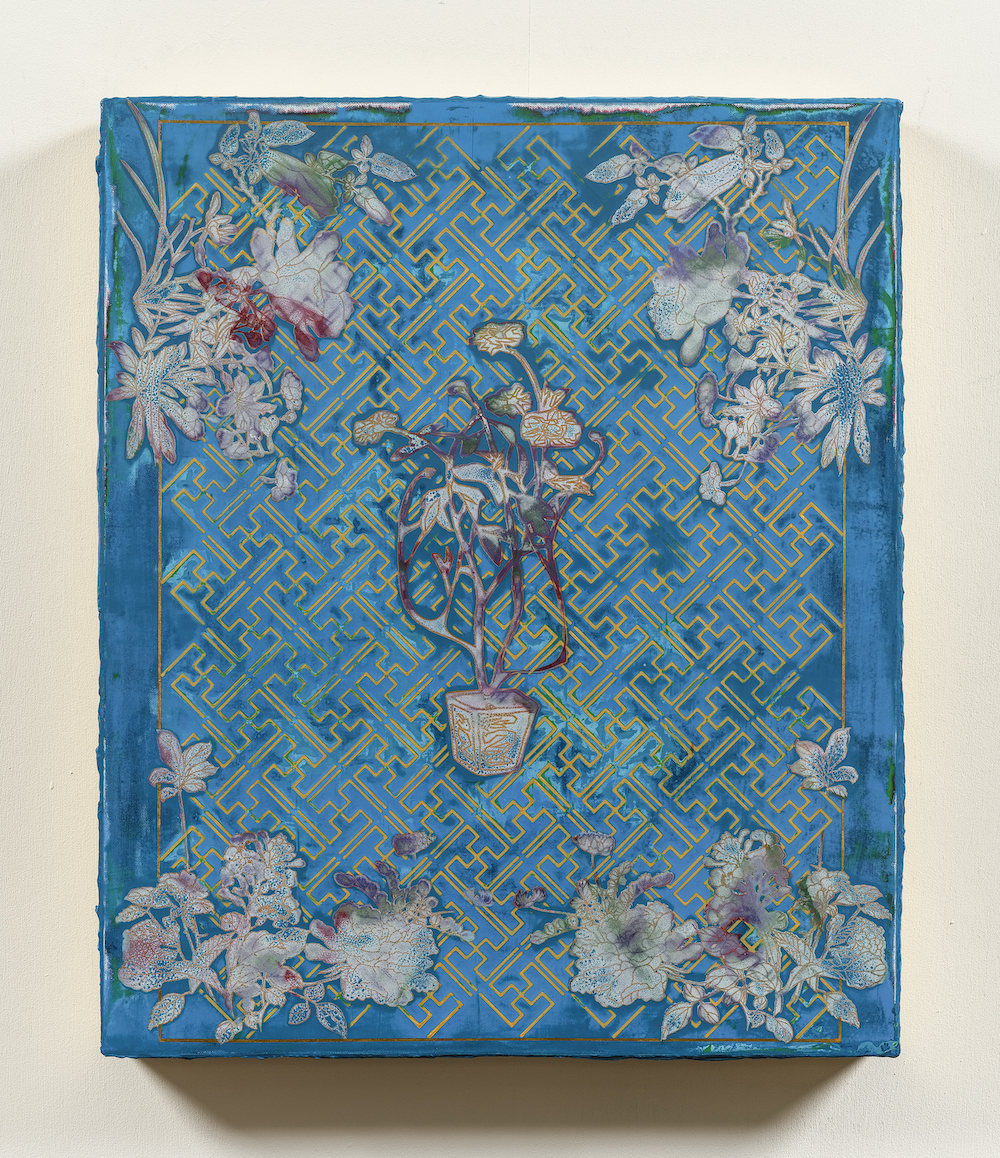
To Lady Durston|2020|Acrylic on canvas|5 x 61 cm
演講題目:異己國情調
倫敦的邦瀚斯 (Bonhams) 拍賣網站上,有一件原為 Anne M.S. Durston夫人所收藏之清朝銅胎掐絲琺瑯四季花卉掛屏,藝術家想像,這位英國女士看著這來自遙遠文化的物時心中油然產生對於東方精緻文物的獵奇,樣式、題材、顏色無一不讚嘆。此「異國情調」(exoticism) 猶如一面鏡子般充斥著取代本地化的幻想空間,脫離現實世界中物的狀態,將慾望安置在異於自己的他者 (otherness) 身份及文化,在異質空間裡共時地穿梭。蘇孟鴻的作品持續用傳統花鳥畫和其裝飾紋樣作為視覺符號,不斷追求其工藝寫實的物象。同時,作品以平塗與絹印手法一層一層堆疊,再將其重複打磨,試圖消弭顏料本身物質性,也隱藏藝術家在創作中的身體勞動過程及時間性。
講者介紹
蘇孟鴻 台灣, 1976
畢業於彰化師範大學美術系、英國倫敦藝術大學金匠學院,畢業於台南藝術大學藝術創作理論博士班。2007年於韓國高陽藝術村駐村期間被當地美術館與策展人注意,所創作的《開到荼靡之變形記》參加2008年釜山雙年展,是國內少數以繪畫見長受邀參展的年輕藝術家。2003年應邀於台北當代藝術館以個展形式展出挪用明清花鳥畫的「開到荼靡」系列。
從蘇孟鴻的繪畫、絹印版畫、裝置與雕塑的創作歷程,可看出他試圖將中國傳統的花鳥畫和其裝飾紋改造成一種艷俗浮誇的視覺圖象;或者用立體裝置的方式,將它們變成一種近似感官訴求的文化符號。作品中經常挪用清代中晚期畫家的花鳥元素,其圖像符號並不單純是社會符碼的嘲諷與普普化,而是將這些花鳥代表的貴族與文人品味,與當代視覺經驗異質且矛盾的作用力融合;令觀者於辨識文化與符號的同時,以回到當下的歷史思考方式進入開放或封閉的系統。如果說人們在郎世寧的畫風中看見中西合筆,蘇孟鴻則是從模擬變塗、螺鈿,甚至掐絲琺瑯等工藝技法處理顏料的物質性呈現,回應東西方工藝歷史的重新配種,也對資本主義中的藝術生產畫上一個問號。
個展經歷包括「異己國情調」(耿畫廊,台北,2021)、「香.奈.兒」(耿畫廊,台北,2019)、「帝國畫師」(耿畫廊,台北,2016)、「罌粟.金蓮.多巴胺」(耿畫廊,台北,2012)、「開不到荼靡 — 以蘇孟鴻為名」(伊通公園,台北,2007);聯展經歷包括「版面.對話 — 台美版畫交流展」(紐約台灣書院,駐紐約台北文化中心,紐約,2016)、台北雙年展(2014)、「反堵:亞洲當代藝術的壅塞文化」(南坡公園藝術中心,布拉克內爾,英國,2009)。