

- DATE : 07/10/2024 23/10/2024
- TIME : 15:00–16:00
- VENUE : West Court Lecture Theatre, Main Building, ECA, 74 Lauriston Place
2024 Spotlight Taiwan Film Festival in Scotland
Part I – Time: 7 Oct 15:00-17:00
*Post-screening Q & A with the film director Hong Jun-Yuan
《YIFANG》(義方)
洪鈞元 Hung Jun-Yuan|臺灣 Taiwan|2023 | Colour|14″48

The film director, Hong Jun-yuan, hails from Chiayi, Taiwan, by way of marriage to a local. His work interweaves the remarkable contributions of his wife’s grandfather from the Japanese colonial era, reflecting the minor yet significant events in the daily lives of Chiayi’s residents during that historical period. Starting with the family history narrative, the discussion delves into the everyday experiences of regular individuals amid major historical shifts. It outlines how pivotal historical junctures have affected individual lives. Moreover, by adopting the perspective of ordinary people, it reconstructs the dispersion and transformations brought by key historical events such as the Pacific War, the Hiroshima atomic bombing, and the issue regarding Taiwan’s sovereignty in relation to the Republic of China. The incorporation of scenes from the markets in Chiayi County and City within the film, juxtaposed with a comparison between the past and present, provides viewers with a retrospective glimpse into the life journey as it unfolds against the backdrop of changing historical eras.
The protagonist of the documentary, Yifang Lin (1926-2018), was born in Chiayi in the 15th year of the Republic of China (Taisho 15th year). When he was young, he went to Hiroshima, Japan to study with his elder brother. During the atomic bombing of Hiroshima in 1945, he happened to leave Hiroshima because of work and survived this disaster.
本片導演洪鈞元作為嘉義女婿,在作品中結合妻子爺爺於日本時代的特殊事蹟,回顧當時嘉義人微小卻至關重要的往事。其中,以家族史敘事出發,談及父祖輩在大時代變動中的常民經歷,細數歷史轉折所加諸於個人的影響。此外,透過小人物的視角,從太平洋戰爭、廣島原爆、台灣歸屬中華民國政府的歷史事件中,還原時代風雲下的離散與流變,而影像中嘉義縣市場景的運用,也藉由今昔對比,回望歷史翻篇間的生命旅程。
紀錄片傳主林義方(1926-2018),民國15年(大正15年)出生於嘉義,青年時期與兄長一同前往日本廣島留學,1945年廣島原爆期間,因恰巧出勤離開廣島市,而幸運的在這次災難中倖存。1946年2月從日本返國後,隨即投入國民教育,1947年又遇二二八事件。這一段流變、離散與居所難以定錨的狀態,以及面對歷史事件猶如失語的情感壓抑,亦反映出當時部分嘉義市民面臨時代困境的縮影,也因為這些歷史與人物間的情景,更能突顯出嘉義市獨特的歷史容貌。離散經驗一直以來是台灣史重要的組成部分,而離散的現象又是由無數台灣人生命經驗所組成。尤其本片人物的留日經歷、台籍日本兵之身份,貫穿太平洋戰爭與戰後政權移轉的劇烈變動。本片以訪談結合田野、重演與非虛構的穿插,試圖塑造私歷史及大時代間的對話及隱喻關係。
Time: 7 Oct 15:00-17:00
《I AM MY OWN HOME》(我是我自己的家)
洪鈞元 Hung Jun-Yuan|臺灣 Taiwan|2023 | Colour|24″07

Jun-Yuan Hong’s works express intense inner emotional issues mainly related to his dysfunctional family of origin. As a result, collaborating with individuals or amateur actors who share similar growth experiences or backgrounds becomes a critical element of his works, allowing him to construct an echo chamber that resonates with his own life.
“I am My Own Home” (2023) is a continuation of Hong’s autobiographical practice, which he initiated in 2018. In this work, he extends the storyline of the “Where do you come from” (2019-2020) series, focusing on the growth of his half-sister. In his earlier works, Hong’s half-sister appeared in two pieces, “Where do you come from-1990: Dissociate” (2020) and “1975 of My Mother and Me” (2020), either with her personal presence or played by a little girl, revealing that she represents the key character in the original family story. However, in the Where do you come from series, the works primarily focus on the mother’s personal and unfortunate experience in her marriage, depicting the epitome of women under the traditional patriarchal society.
Expanded on the concept mentioned earlier, “I am My Own Home” (2023) delves deeper into the emotional repressions faced by female characters in traditional families. The growth experience of Hong’s half-sister is used to compare the role of mothers as supportive figures in family relationships. The events of his sister’s life, living in two families with dual roles, serve to evoke the emotional contradictions inherent in human nature. The video portrays the older sister growing up between her mother’s two marriages. Throughout her childhood, she faced various relocations, separations, and changes that left her unable to find stability. In adolescence, upon returning to her mother’s first husband’s family, she struggled to adapt and could only conceal her emotions in the school dormitory. Looking back on her past after growing up, she feels distressed about the situation she encountered during her youth and the helplessness she experienced in dealing with her original family.
洪鈞元作品帶有強烈的內在情感問題,主要原因來自於他的破碎原生家庭。因此,藝術家在作品中尋找具有相似成長經驗的對象或素人演員,成為創作中的關鍵元素,進而建構屬於自身生命體的共感同溫層。
本次創作延續藝術家2018年所開啟的自傳式創作實踐,並藉由「你是哪裡人」(2019-2020)系列進行創作支線的延伸,聚焦於同母異父姊姊的成長際遇。過去作品中,姊姊的形象分別出現於〈你是哪裡人-1990:解離〉(2020)與〈你是哪裡人-1975:我與母親的民國六十四年〉(2020)兩件作品裡,以親自現身以及小女孩的扮演,透露出在原生家庭故事中所佔有的關鍵角色。但在「你是哪裡人」系列,作品聚焦處理的是母親個人婚姻經歷的哀傷際遇,及在傳統父權結構底下的女性縮影。因著前述的創作概念,〈我是我自己的家〉(2023)更強化女性角色於家庭倫理中的情感壓抑,以同母異父姊姊的成長遭遇,對比母親作為家庭關係裡的角色支撐。換言之,身為子女又具備雙重家庭角色的姊姊,其生命事件更能喚起人性的情感矛盾。錄像作品中描述了姊姊在母親兩段婚姻之間的成長過程。在童年時期,歷經離散、流變與無法定錨的各種搬遷,至青少年時期,回到原生父親(母親第一段婚姻)家庭的不適應,而將自身情感藏匿於學校宿舍。到了成年後,回憶過去時心疼自己年少時期的處境,以及面對原生家庭所產生的無奈與力拙。
Time: 7 Oct 15:00-17:00
《GAP / SEAM》(縫)
洪鈞元 Hung Jun-Yuan|臺灣 Taiwan|2021 | Colour|14″32
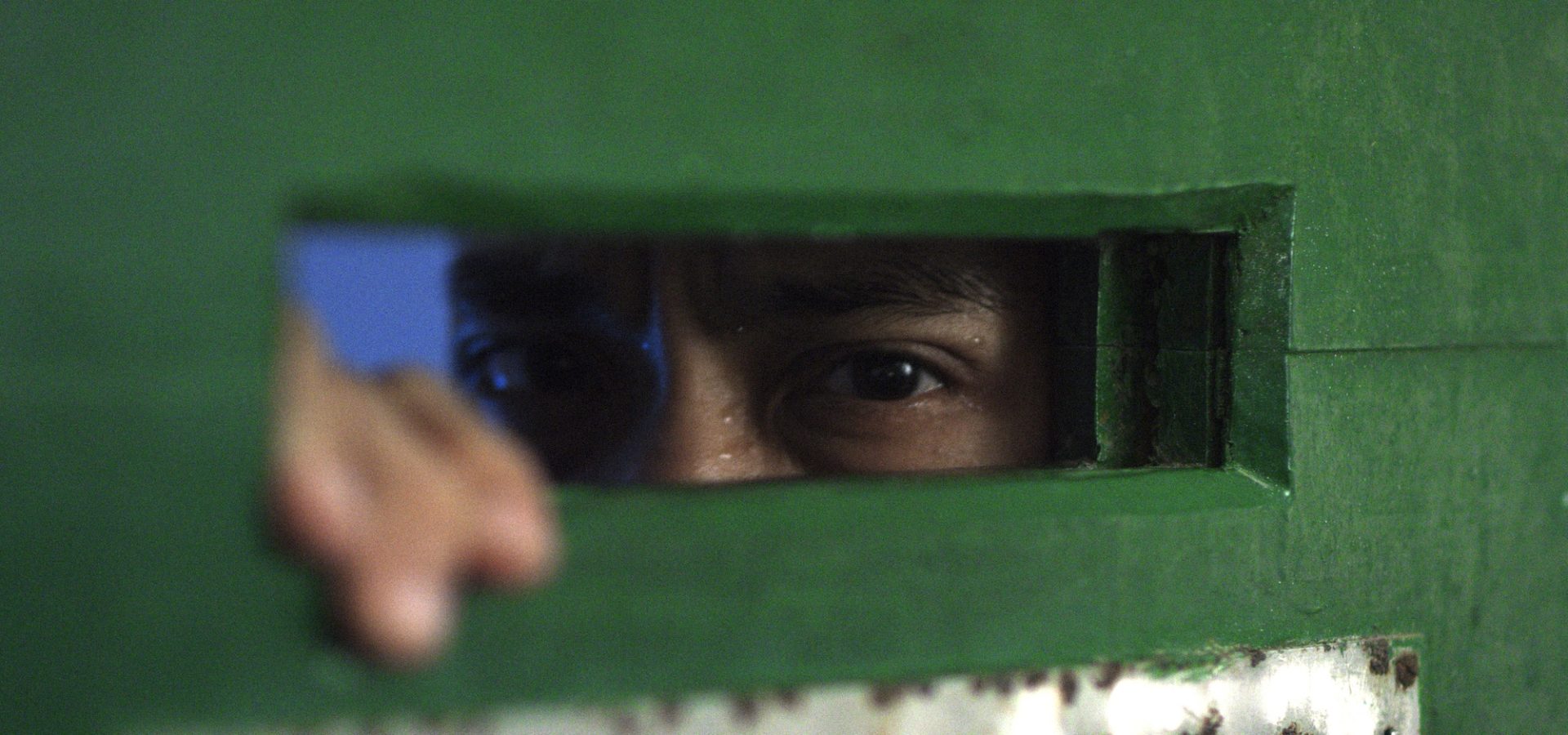
There are all kinds of gaps and seams in the prison environment, be it crevices and door seams towards the outside of prison cells or gaps and openings created by cell window bars. They constituted the everyday landscape in the eyes of political prisoners. However, phonetically speaking, the meaning of the Mandarin character “縫” is twofold: when pronounced in the fourth tone, the character denotes crevices, openings or gaps; but when pronounced in the second tone, it is used as a verb that means “mending” or “sewing.” The work is based on such a contronymic concept to respond to the contradictory relationship between the political prisoners in White Terror and the state power.
Jun-Yuan Hong films the process of a political prisoner’s failed jailbreak. After a tortuous, oppressive and suffering journey, as he gazes into the sea at the exit, the escape eventually becomes a self-contradictory exhaustion. In addition, memories of Tu Nan-Shan, a White Terror victim who was imprisoned on Green Island, are interwoven with the political imprisonment of Lin Bi, the great-great-grandfather of actor Sing-Ho Yeung, overlapping life stories and metaphorical narratives from different eras.
監獄環境中存在著各式各樣的「縫」,無論是牢房的對外孔隙、門縫,或外窗柵欄所切分出的空洞,組成關押政治犯的日常視野。然而,中文字的「縫」在語音上,同時具有兩種相對的含義,如讀四聲,為描述缺口與裂隙之意。相反地,讀音為二聲時,則作為「修補」的動詞,例如縫紉。據此概念,回應白恐政治犯與國家權力間兩面的矛盾關係。
洪鈞元拍攝了政治犯逃獄失敗的過程,其經過一段曲折、壓迫與苦難的路徑後,望向無處可逃的大海,最終成為一種自我矛盾的消耗。此外,作品借用白恐政治犯涂南山前輩於綠島被關押的回憶,以及演員楊昇浩高祖父林壁於日治時期,亦因政治因素被判刑入獄之事件,進行時空交錯的生命層疊及敘事隱喻。
Part II
Time: 23 Oct 2024 15:00 – 16:00
《ABIDING NOWHERE》(無所住)
蔡明亮 Tsai Ming-Liang|臺灣 Taiwan|2024 | Colour|79 mins

Abiding Nowhere is the 10th in an ongoing series of works known as the Walker series, which Tsai Ming-Liang has produced independently from the museum since 2012. Abiding Nowhere is the first in the series to be made in the United States. It was shot in the museum’s Freer Gallery of Art and other Washington, D.C. locations.
Inspired by Xuanzang, the seventh-century monk who walked from China to India and became the inspiration for the famed literary work A Journey to the West, the Walker films all feature Tsai’s creative partner Lee Kang-sheng in the robe of a Buddhist monk, who has the uncanny ability to move very slowly, interacting with landscapes and people in cities all over the world.
